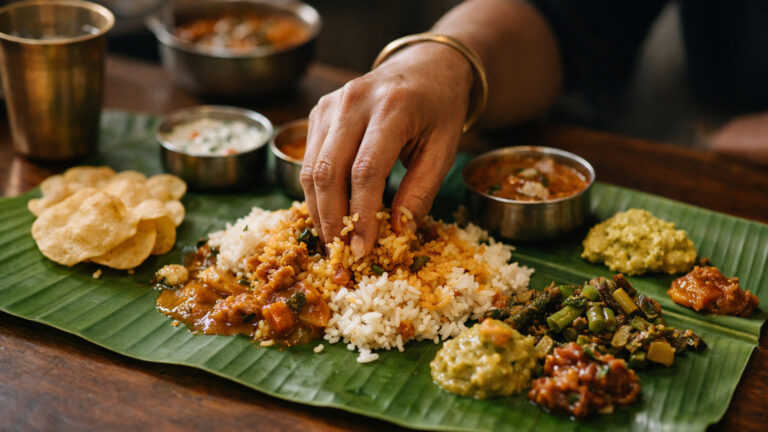

Your Mother Didn’t Use a Recipe. That Was the Point.
How South Indian mothers became the keepers of an entire culinary tradition — without ever writing a single thing down.
Ask anyone who grew up in a South Indian household how their mother made sambar.
Watch what happens to their face.
There will be a pause. A small, involuntary smile. And then, almost without fail, some version of the same answer: “I don’t know exactly. She just knew.”
Not she followed a recipe. Not she measured it out. She just knew. She had always known. And somewhere, quietly, so had her mother before her, and her mother before that.
This is the story of the most important chef in South Indian cooking. She doesn’t have a Michelin star. She never wrote a cookbook. She probably wouldn’t describe herself as a chef at all.
She’s your mother. And she is the reason South Indian food tastes the way it does.
She Didn’t Measure. She Felt.
The measurements of a South Indian kitchen are not written in grams or teaspoons. They exist in a language that doesn’t translate to paper particularly well.
A handful of this.
A small fistful of that.
Cook it until it smells right.
You’ll know.
If you ever stood next to her with a pen, trying to write it all down, you know exactly how that went. She’d add something, you’d ask how much, and she’d look at you with genuine confusion — not because she was being difficult, but because the question didn’t quite make sense to her. She didn’t know how much. She just knew when it was enough.
This is the oral tradition of South Indian cooking — a system of knowledge transmission that has operated for thousands of years without a single written recipe. It’s not a gap in the record. It was never meant to be written down. The knowledge wasn’t stored in books. It was stored in people. Specifically, in mothers.
What she was giving you wasn’t a list of ingredients. It was a sense — built up over years of watching and doing and adjusting. She could judge doneness by sight, heat by touch, balance by smell. The analytical mind wasn’t involved. Her hands simply knew what to do.
Your Mother Was the Recipe
Every South Indian mother carries within her a culinary archive that belongs only to her family.
Her version of sambar is slightly different from the neighbour’s. Her fish curry has a particular sourness that nobody else’s quite replicates. Her spice mixture — ground, toasted, blended to a ratio she learned from watching her own mother — is entirely her own. Not dramatically different from anyone else’s, but hers. A small, specific inheritance, tweaked across generations.
Archana Pidathala, author of Five Morsels of Love, spent years reconstructing her grandmother’s 1974 Telugu cookbook — a project she describes as both a labour of love and a form of archival rescue. What struck her was not just the recipes themselves, but everything surrounding them: the handwritten notes, the seasonal adjustments, the small personal touches that revealed a woman’s entire relationship with cooking. A life, encoded in a recipe book.
Most South Indian mothers never even had a recipe book. The encoding happened differently — in kitchens, at stoves, in the act of standing beside someone and paying attention.
Your mother was the recipe. The whole thing lived in her.
The Kitchen Was the Classroom
In a traditional South Indian household, nobody sat you down and formally taught you to cook.
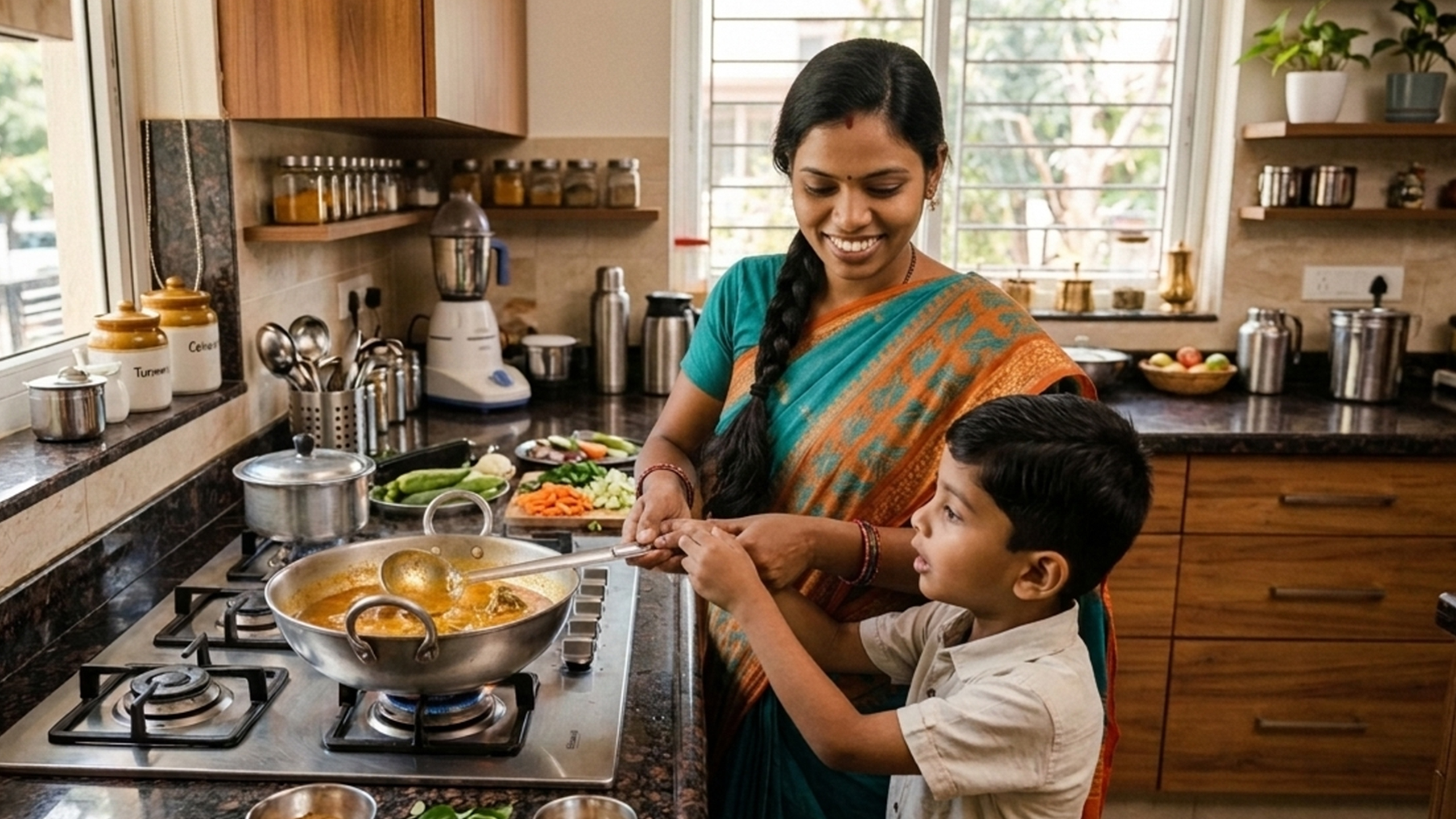
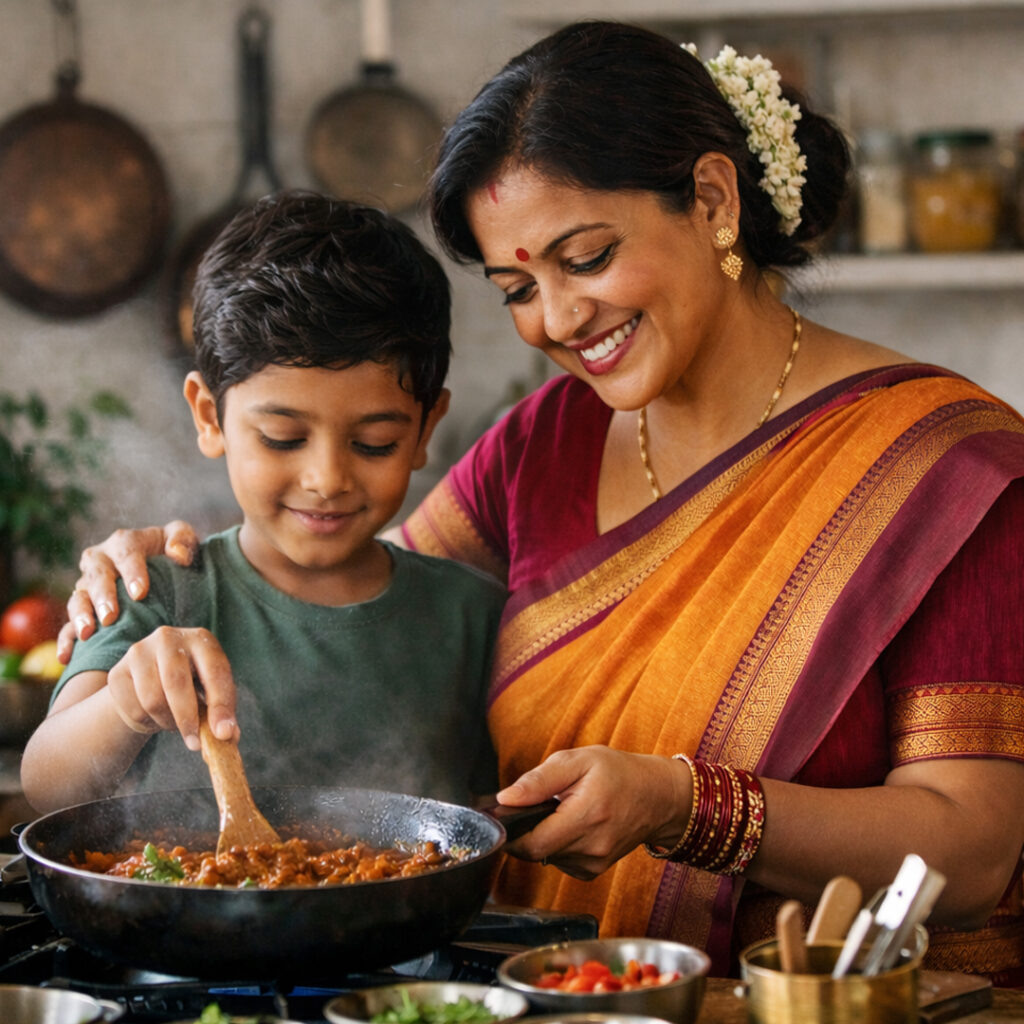
You learned by being there. By hovering near the stove when you were small. By being handed small tasks — washing the rice, grinding the coconut, sorting the lentils — that kept you close enough to watch without being in the way. By absorbing, over years, the rhythm and logic of a kitchen that your mother ran without ever seeming to think about it.
She knew when the mustard seeds were ready to receive the curry leaves — that specific crackling sound, that particular smell of hot oil and temper. She knew the exact amber colour of onions that meant they were ready to move to the next stage. She understood intuitively that on a humid day the tamarind would need longer, that in winter the dough would need a little more water.
Researchers who have studied this kind of embodied culinary knowledge describe it as one of the most sophisticated forms of practical intelligence — a deep, multisensory understanding of food that takes years to develop and can’t be shortcut by reading a book.
Your mother had it. She probably didn’t know she had it. It was simply what she did.
She Fed You. She Fed Everyone.
There is something else your mother understood, that no recipe can capture.
Food, in South Indian culture, is not just fuel. It is an act of love made visible. The Mumbai Dabbawala network — which has operated for over a hundred years, delivering home-cooked tiffin boxes to workers across the city with an extraordinary error rate of just one mistake per six million deliveries — exists for precisely this reason. Because eating food made by your mother is understood to be categorically different from eating food made by anyone else. It is nourishment that carries something extra with it.
She cooked for you when you were ill, making the specific dishes that she knew — that her mother had known — would help. She cooked the right things at festivals, at weddings, at the meals that marked every important transition. She understood, without having to articulate it, that cooking for someone is one of the most direct ways of saying: I see you. I know you. You are cared for.
In South Asian diaspora communities, researchers have found that food is one of the most powerful ways that displaced families maintain a connection to home. People who have lived in Glasgow or London or Toronto for decades still cook — or try to cook — what their mother made. Not out of nostalgia exactly, but out of something deeper. A need to stay connected to something that migration can loosen but never entirely sever.
What Happens When We Stop Watching
Here is the part nobody wants to think about.
Your mother’s knowledge is not immortal. It lives in her — and only in her — until it is passed on or it is lost.
Research has shown that food memory and smell are among the most emotionally powerful experiences we have, connecting directly to the brain’s emotional centres in a way that bypasses rational thought entirely. Harvard neuroscientist Venkatesh Murthy explains that odours take a direct route to the amygdala and hippocampus — the regions responsible for emotion and memory — which is why a single mouthful of a dish your mother made can return you, completely and instantly, to a kitchen you haven’t stood in for twenty years.
That memory is real. But it isn’t transferable on its own. The taste of the memory is not the same as the knowledge of how to make it.
When a South Indian mother dies without having passed on what she knew, what goes with her is not just a recipe. It is the specific logic beneath the cooking — the why behind everything. Why this spice in this season. Why the tempering is done in this order. Why this dish belongs to this occasion and not that one. The accumulated wisdom of a lifetime, and every lifetime before hers.
Studies of urban South Indian communities have found that younger generations are increasingly disconnected from the cooking traditions of their parents and grandparents — not out of indifference, but simply because modern life doesn’t leave much room for standing in the kitchen watching someone cook.
That’s the gap through which the knowledge slips.
Pay Attention While You Still Can
There is nothing complicated about what needs to happen.
You don’t need to write it down — though you could. You don’t need to film it — though that wouldn’t hurt. You just need to be there. In the kitchen. Near the stove. Watching.
Ask her why she does it that way. Ask her where she learned it. Ask her what her mother made that she’s never quite managed to replicate. Ask her what the food was like when she was growing up, and who taught her, and whether she thinks she got it right.
She’ll probably wave the questions away. She’ll say it’s nothing special, that she’s just cooking, that there’s nothing to learn here that you couldn’t figure out yourself.
She is wrong about that.
Your mother didn’t use a recipe because she didn’t need one. Everything she knew, she carried. Everything she carried, she learned from watching someone she loved.
The best thing you can do now is watch her back.
Experience gluten-free South Indian food in Glasgow
Madurai is a South Indian restaurant at 142a St Vincent Street, Glasgow G2 5LQ. Fully gluten free and Coeliac UK accredited.