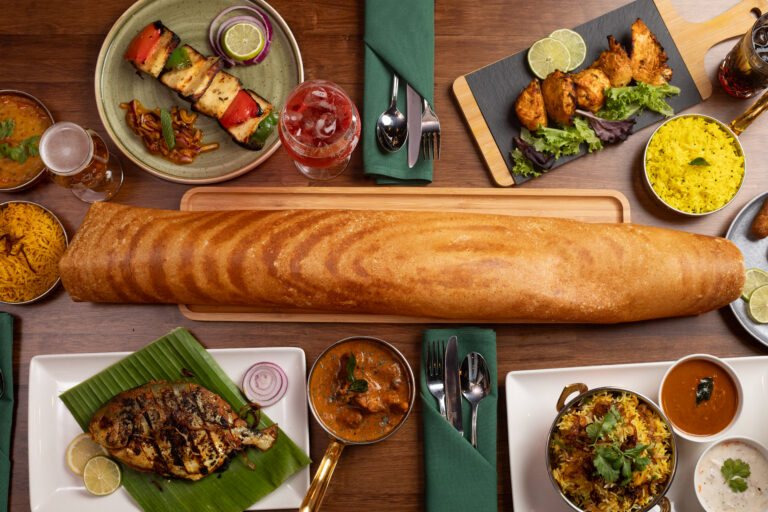

The Thali: The Lunch That Has Not Changed in Three Thousand Years
There is a moment at Madurai, usually around the time a second drink has arrived and the conversation has found its footing, when a thali landing on the table creates a kind of joyful confusion. Where do you start? Which bowl first? Is the rice the main thing, or is the main thing everything else?
The correct answer is all of it, simultaneously. That is not indecision on the part of the kitchen. It is the entire point — and the reasoning behind it goes back roughly three thousand years.
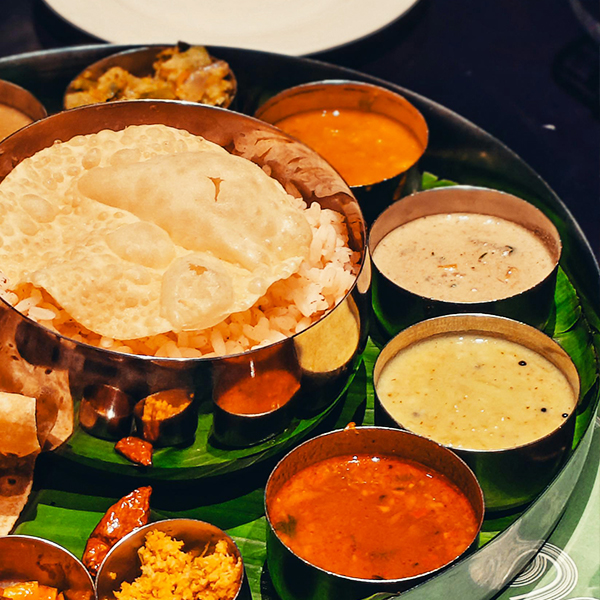
What is a South Indian thali?
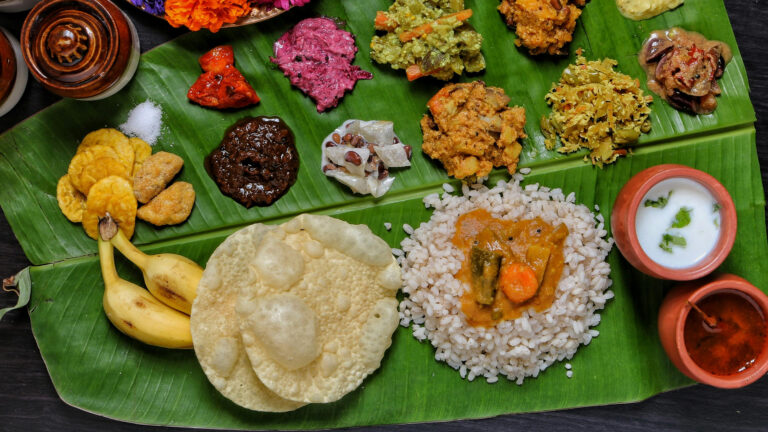
The word simply means plate. According to food historian K.T. Achaya’s A Historical Dictionary of Indian Food, the term traces back to the Sanskrit word sthali — not a plate at all, but a Vedic-era pot used for boiling rice. From pot to plate is a reasonable journey. The plate that evolved was round, with slightly raised edges, surrounded by small bowls called katoris — a format that has been recognisable, food historians suggest, since at least the Iron Age.
What makes a thali more than a vessel is the philosophy of what goes into it. In Ayurvedic tradition, a proper meal should contain all six tastes — sweet (madhura), salty (lavana), sour (amla), pungent (katu), bitter (tikta), and astringent (kashaya) — eaten not in sequence, but together. The body needs all six to function in balance. This system, called Shadrasa, was codified in medical texts at least two thousand years ago, and has quietly underpinned South Indian cooking ever since.
A thali, built well, hits all six. That is not coincidence. It is architecture.
A brief and entertaining history
The earliest written instructions for laying out a thali appear in the Sushruta Samhita, an ancient medical text dedicating an entire chapter to dining etiquette: the correct placement of every dish, pulses here, rice there, soups on the left, sweets to the right. It reads less like a recipe and more like stage directions for a performance the body needs to feel.
By the Mauryan Empire, the format had gone upscale. The Greek ambassador Megasthenes, visiting the court in the third century BC, wrote home describing golden bowls of rice and spiced preparations placed before each diner. Centuries later, Portuguese ambassador Domingo Paes visited the Vijayanagara Empire and noted three-legged golden stools bearing dishes in smaller basins of gold, some set with precious stones. The copper and stainless steel version you will encounter at lunch on St Vincent Street in Glasgow is, structurally, the exact same meal.
The thali is believed to have originated in South India, where rice has always been the anchor of every meal — the centre of the plate around which everything else orbits. By the fifteenth century, it was a fixture in royal households. Traditional etiquette, according to chef Maharaj Jodharam Choudhary, held that no one could leave the table until everyone had finished. The thali was not just food. It was a social contract with sides.
How a South Indian Thali differs from what most people expect
South Indian food and North Indian food are not really the same cuisine in different postcodes. They share a country and some spice cupboard overlap, but the philosophies diverge considerably. And this matters if you are trying a South Indian thali in Glasgow for the first time.
Northern thalis lean on wheat-based breads, dairy-rich gravies, and dishes with a significant debt to Mughal court cooking: layered, rich, built around paneer or meat in heavy sauces. South Indian thalis are built around rice, lentils, coconut, tamarind, and a spice palette dominated by mustard seeds, curry leaves, turmeric, and black pepper. The flavour profile is brighter, more acidic, more aromatic. Tamarind provides the sour, coconut the sweet, lentils the bitter, pickle the astringent, chilli the pungent. The salt looks after itself.
Everything also arrives at once. You eat it in whatever order or combination you like — a spoonful of rice with curry and sambar and a fragment of poppadom all in one go. Food historian Colleen Sen notes that ancient Hindu dietary theory specified sweet first and astringent last, but today the formality has softened. The principle — that the meal works as a whole rather than as individual components — has not.
It is also worth noting that the whole format is naturally gluten free. South Indian cooking’s reliance on rice, lentils, and coconut rather than wheat is not a modern dietary accommodation. It is simply how the cuisine works. Madurai Glasgow holds full Coeliac UK accreditation, meaning the kitchen controls are in place for anyone with coeliac disease or gluten intolerance to eat with complete confidence.
What comes in the thali at Madurai Glasgow
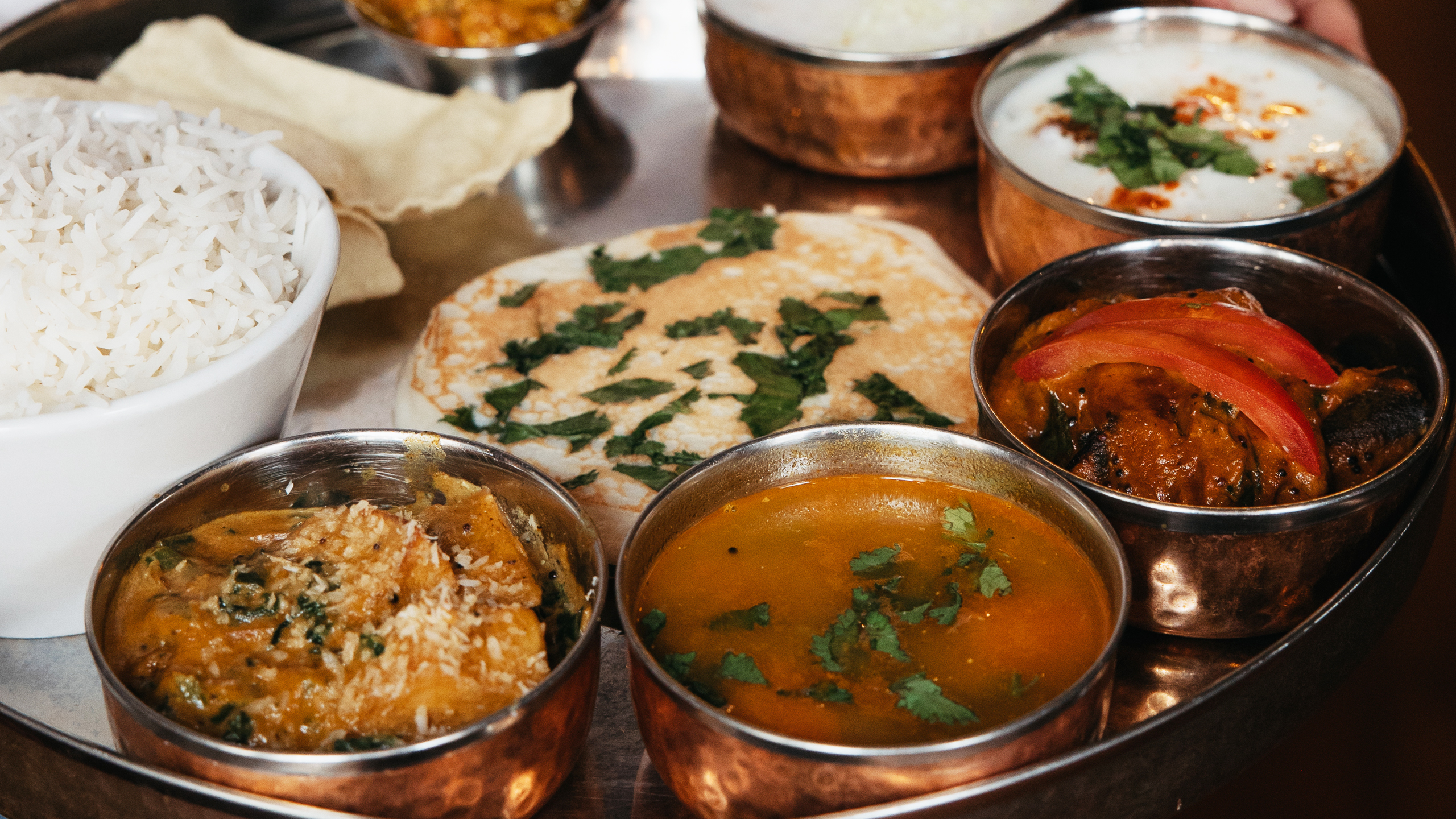
Madurai offers four thalis at lunch: seafood (monkfish and prawns, £19), meat (chicken and lamb, £16), vegetarian (paneer and vegetables, £15), and vegan (two vegan curries, £16). Every thali includes the same accompaniments: sambar, raita, mini uttapam, steamed rice, pickle, poppadom, and payasam.
Here is what each element actually is.
The Two Curries
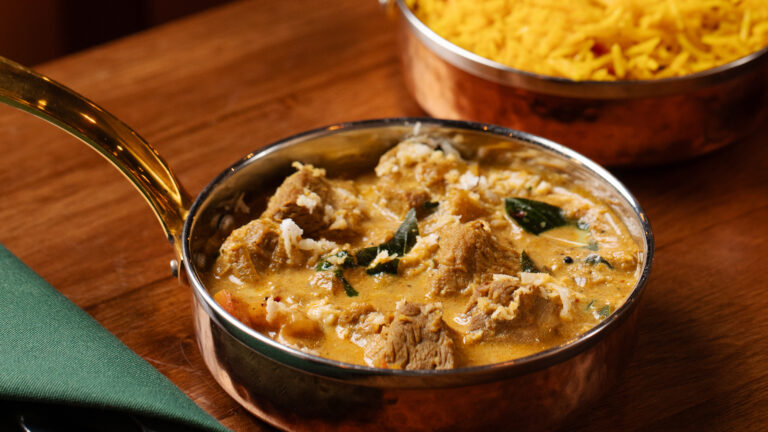
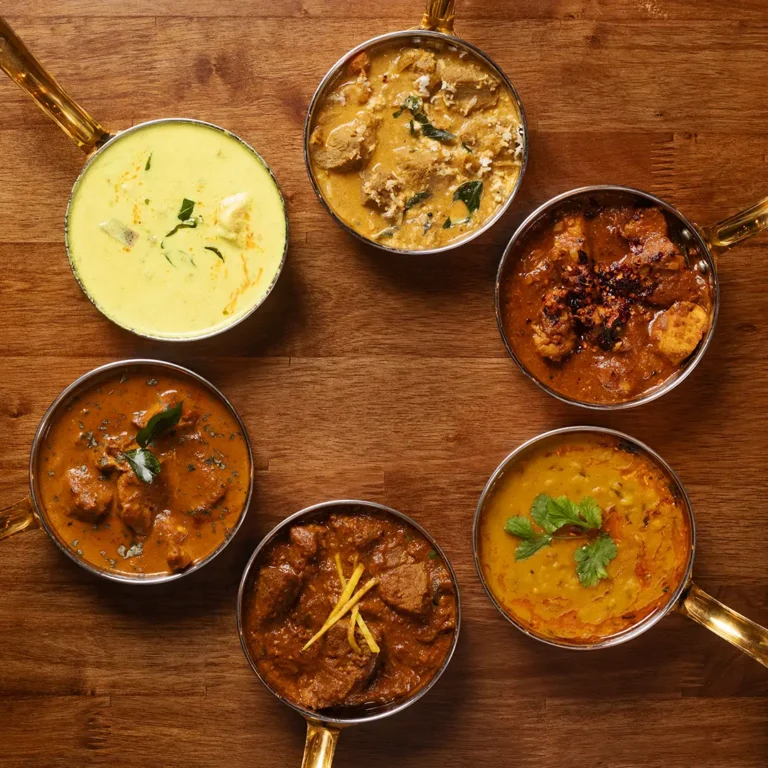
The two curries are the primary flavour statement of the thali, the dishes everything else is built around. They are not there to be eaten separately and admired. They are there to be combined with rice, layered with sambar, cut through with pickle, eaten in whatever order and proportion you like. One is always richer, one lighter. That contrast is intentional.
At Madurai there are four thalis to choose from. The seafood thali pairs monkfish and prawns, prepared in the coastal South Indian style with coconut milk, turmeric, and curry leaves. The meat thali pairs chicken and lamb. The vegetarian thali pairs paneer with a vegetable curry, drawing on a tradition where plant-based cooking has always been the foundation, not an alternative. The vegan thali features two fully plant-based curries.
Sambar
One of the most interesting dishes with an origin story in South Indian cooking. The most widely circulated legend traces it to the seventeenth-century court of the Thanjavur Maratha ruler Shahuji I. A visiting royal tried to cook a traditional Maharashtrian lentil soup and, finding no kokum (the sour fruit it required), substituted tamarind. The result was named after him. Food historians are sceptical of the exact story — one describes sambar as “a recent classic pretending to be timeless” — but the sambar itself is beyond dispute: spiced lentil stew with tamarind and vegetables, doing two jobs on the thali, keeping the rice loose and scoopable while delivering the sour and pungent notes the Shadrasa system requires.
Raita
Cooling yogurt — not the star, but almost medicinal in function. It cools the heat of the spices and settles the stomach between bites. In Ayurvedic terms it balances pitta, the fiery quality that chilli and tamarind can aggravate. You may not consciously think about this while eating, but the balance is working on you regardless.
Mini Uttapam
A fermented rice and lentil pancake — thick and spongy where its cousin the dosa is thin and crisp. Its name comes from the Tamil words appam (pancake) and utthia (poured). Food historians believe uttapam originated as the solution to a very practical kitchen problem: leftover dosa batter that had fermented too long to spread thinly. Rather than discard it, South Indian cooks poured it into a thicker layer and fried it. The result was so good it became its own dish. On the thali it arrives as textural counterpoint — soft, slightly tangy, something to scoop and fold through the curries.
Steamed rice
Rice to a South Indian is what pasta is to an Italian: not a side, not a filler, but the grammatical base of the meal, without which the sentence does not make sense. The curries, the sambar, the pickle — they are all, in a sense, clauses. The rice is the subject.
Pickle
Brings the astringent and sour hits the Shadrasa system demands. In South Indian cooking, pickles are made with seasonal ingredients preserved in oil, salt, and chilli. Used in small amounts — a pinch with each mouthful of rice and curry — the effect is like turning the brightness up on everything else.
Poppadom
Crisp, airy, made from lentil flour. It is the only element of the meal that is not soft, wet, or warm. Its presence is partly structural. Something on the plate has to crunch.
Payasam
This is where things get genuinely ancient. The dish traces its origins to the Rigveda, composed between 1500 and 1200 BCE, where milk-based sweet preparations appear as ritual offerings. Payasam — rice cooked slowly in milk, sweetened with jaggery, scented with cardamom — is arguably one of the oldest continuously prepared desserts in existence. There is a Kerala legend involving it: Lord Krishna, disguised as a sage, defeats the king of Ambalapuzha at chess. His prize is not gold, but the instruction that the temple must serve free payasam to every pilgrim who arrives. The temple is still doing it. On the thali, payasam arrives last for an Ayurvedic reason — the meal that opened with the sweetness of coconut closes with sweetness again, bookending the six tastes. It is the full stop on a sentence three thousand years in the making.
Why it works as a meal
A well-composed thali feels filling in a way that heavy food rarely achieves, because it is genuinely complete. Every nutritional category is present. Every taste is covered. The fermentation in the uttapam aids digestion. The tamarind and spices in the sambar are, in Ayurvedic terms, a daily prescription disguised as comfort food. The raita cools what the pickle inflames. The payasam closes the loop.
Three thousand years is a long time for any format to still be relevant. The thali has earned it.
FAQs
South Indian thali at Madurai, Glasgow
Thali Lunch from £15, Monday to Friday, 12:00 – 15:00
Seafood • Meat • Vegetarian • Vegan
142a St Vincent Street, Glasgow G2 5LQ
5 min walk from Glasgow Central Station
Our entire menu is naturally gluten free, and we’re one of only a handful of restaurants in Glasgow to hold full Coeliac UK accreditation. So if you’re coeliac, gluten intolerant, or just someone who likes bold, properly made South Indian food, come in.