
Why South Indians Eat With Their Hands And Why It Makes Food Taste Better
There’s a moment that happens in every South Indian home, probably around the age of four or five, when a child is handed a fork at the dinner table — and promptly ignores it.
Not out of defiance. Not because nobody taught them. But because in South Indian culture, eating with your hands isn’t the absence of manners. It’s the presence of them.
And here’s the thing: there’s real science — and thousands of years of philosophy — behind why.
The Fork Is a Relatively New Idea
Let’s start with some uncomfortable context for anyone feeling smug about their cutlery.
The fork, as a standard dining tool in Britain, only became widely used in the 18th century. Before that, most of the world — including kings, emperors, and the entire aristocracy — ate with their hands. In fact, when the fork first appeared in England in the early 1600s, it was considered effeminate and unnecessary. Thomas Coryate, a British traveller, is credited with introducing forks to England in 1608 after seeing them used in Italy — and was widely mocked for it.
Even more striking: when a Byzantine princess brought a golden fork to Venice in the 11th century, a senior Catholic theologian named Peter Damian publicly condemned her for the extravagance of refusing to eat with her God-given fingers. He suggested her early death was divine punishment for the vanity of using metal cutlery.
South India, meanwhile, had been refining the art of hand-eating for thousands of years. This wasn’t a culture that never discovered the fork. It was a culture that looked at the fork and thought: why?
The Science: Your Hands Know Things Your Mouth Doesn’t
Here’s where it gets genuinely interesting.
Your fingertips contain nerve endings that send signals to your brain before the food even reaches your lips. The moment you touch warm rice, feel the texture of a dosa, or press your thumb into a spiced curry, your brain is already preparing your digestive system — triggering saliva production and enzyme release before the first bite.
A 2022 study published in the International Journal of Gastronomy and Food Science reviewed the growing body of research on eating with hands versus cutlery and found measurable differences in how people experience and perceive food. The research concluded that tactile interaction with food before eating increases sensory anticipation and flavour intensity. Touching your food makes it taste better — not as a metaphor, but literally.
A separate study from Stevens Institute of Technology, published in the Journal of Retailing, found that people who touch food directly with their hands find it tastier, more satisfying, and more appealing than those using cutlery. The researcher, Dr. Adriana Madzharov, concluded that direct touch triggers an enhanced sensory response — making food more desirable before a single bite is taken.
There’s also the temperature element. Your hands can sense heat far more precisely than a metal spoon. Fingertips are designed to gauge temperature far more accurately than a fork or spoon — helping you manage the balance between hot, warm, and cool elements of a meal in a way that metal cutlery simply can’t replicate.
The Right Hand Has One Job
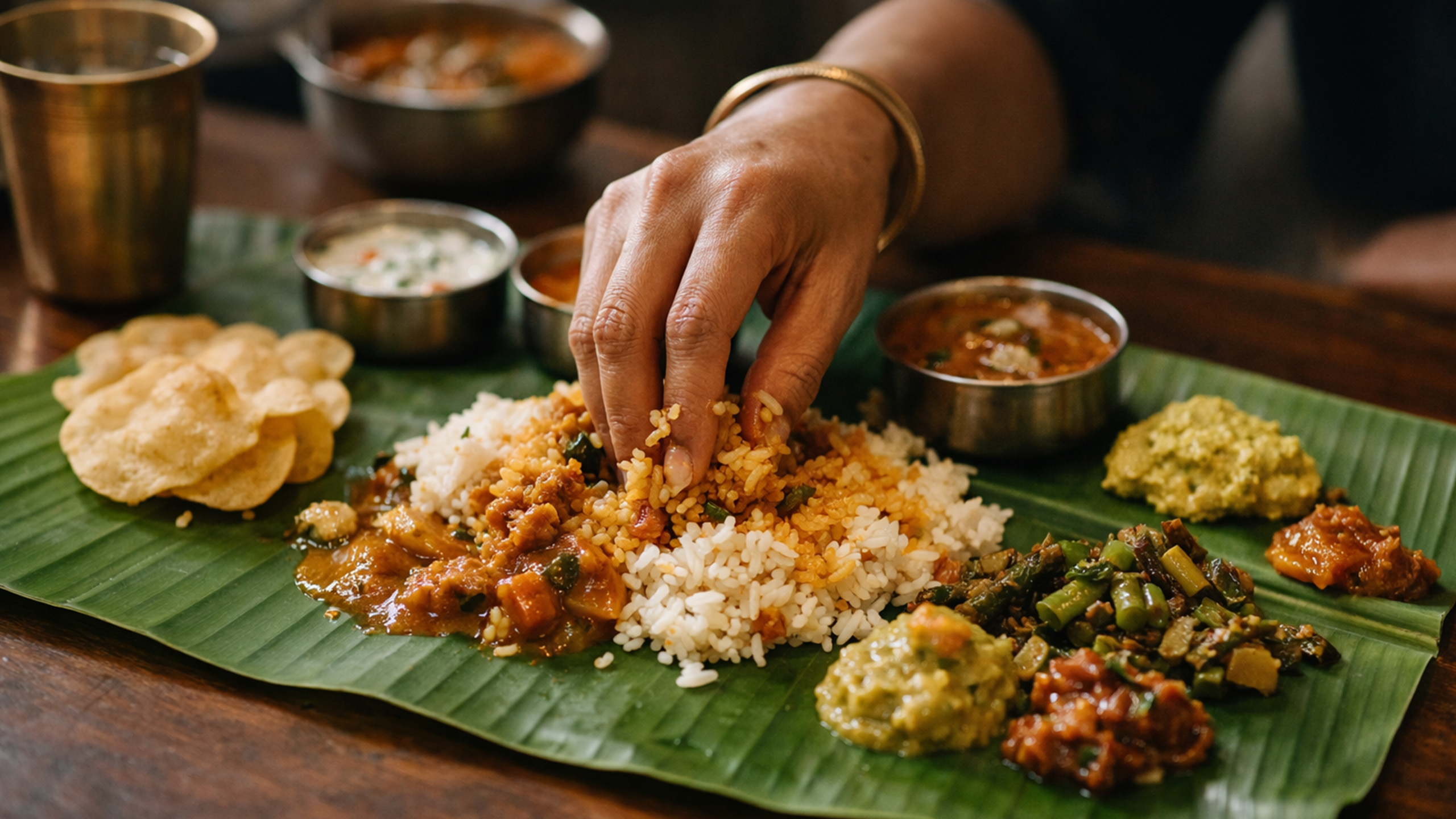
If you’ve eaten at Madurai or spent any time around South Indian food culture, you may have noticed that only the right hand is used for eating. The left hand stays off the plate.
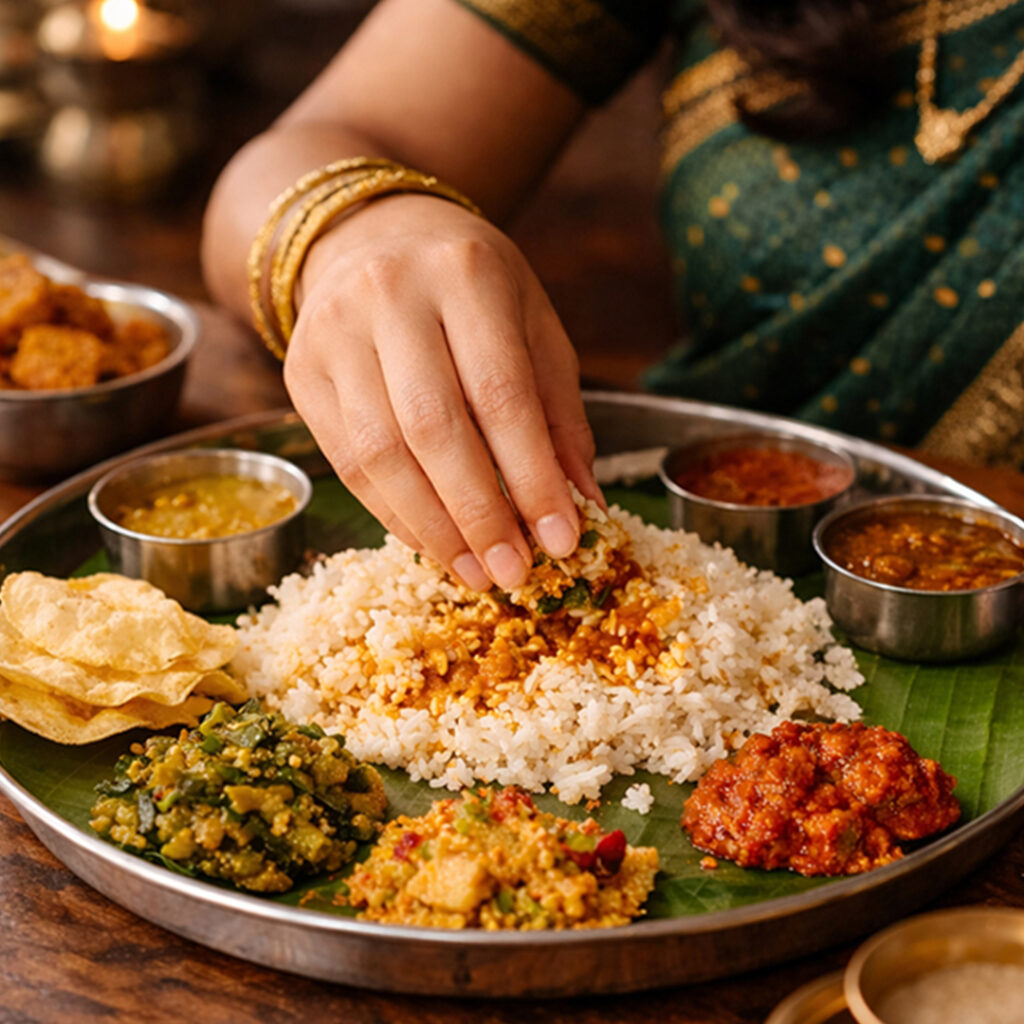
This isn’t arbitrary. In Ayurveda — the ancient Indian system of medicine still widely practiced today — the right hand is considered active and warm, associated with energy and vitality. Eating with it is believed to activate the body’s digestive energy, known as agni, or digestive fire. The act of kneading rice and curry together, of folding food into a small portion before lifting it to the mouth, is almost meditative — a physical engagement with what you’re about to consume.
And the technique itself matters. There’s a specific way to do it: use the tips of your fingers, not the palm. Scoop from below, not stab from above. Keep your wrist clean. The elegance, once you’ve seen it done properly, is striking — a long way from the messy caricature that people who’ve never tried it might imagine.
Why It Changes the Taste of the Dosa
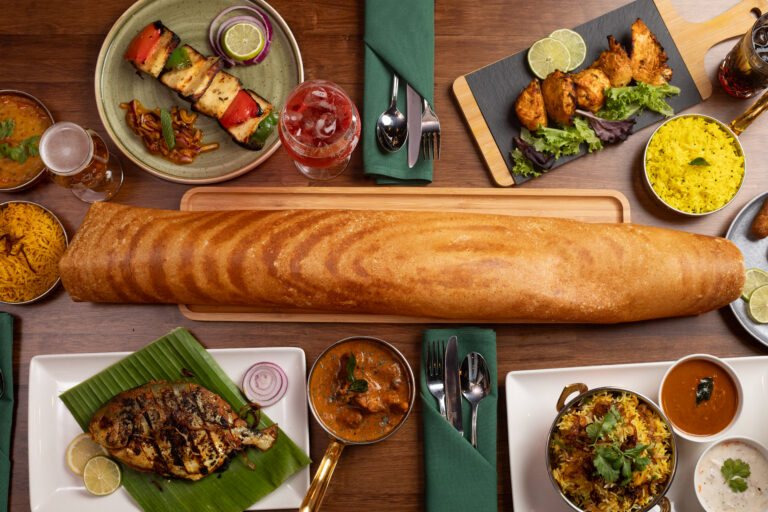
At Madurai, our dosa is fermented, crisp on the outside, and served with sambar and coconut chutney. You can eat it with a knife and fork. Many of our Glasgow guests do. But there’s a reason our South Indian guests will fold a piece of the dosa into a small cup shape with their fingers, dip it into the sambar, and eat it in one movement.
The dosa breaks differently in your hands than under a knife. The crisp edge shatters the way it’s supposed to. The fold creates a pocket that holds the sambar. The ratio of dosa to dipping sauce in each mouthful is something you control instinctively, not mechanically.
It’s the same reason sushi chefs in Japan will tell you to eat nigiri with your hands rather than chopsticks. The compression matters. The texture matters. The temperature matters. And hands, it turns out, are extraordinarily good at managing all three simultaneously.
It’s Also About Something Deeper
There’s a Sanskrit phrase: Annam Brahma — food is God.
In South Indian tradition, a meal isn’t simply fuel. It’s an experience that involves all five senses: sight, smell, sound, touch, and taste. Neuroscience research shows that the pleasure of eating is linked to sensory expectation — when you see, smell and touch food, the brain releases dopamine before you’ve even taken a bite. Eating with your hands doesn’t remove the ritual of the meal — it completes it.
When you pick up food with a fork, you hold it at a distance. When you eat with your hands, you are part of it.
Should You Try It?
Honestly? Yes. Not because it’s a novelty, and not to be performative about it. But because food genuinely tastes different when you engage with it fully.
Next time you visit Madurai, try it with your rice dish or your dosa. Use your right hand. Use your fingertips, not your palm. Mix the rice and curry together first — don’t be shy, this is actively encouraged — and form a small amount before lifting it to your mouth.
You might feel slightly self-conscious for about thirty seconds. And then you’ll realise you’re tasting the food properly for the first time.
Some habits are thousands of years old for a reason.
FAQs
Experience gluten-free South Indian food in Glasgow
Book your table at Madurai or call 0141 221 7722
Madurai, 142A St Vincent Street, Glasgow, G2 5LQ